


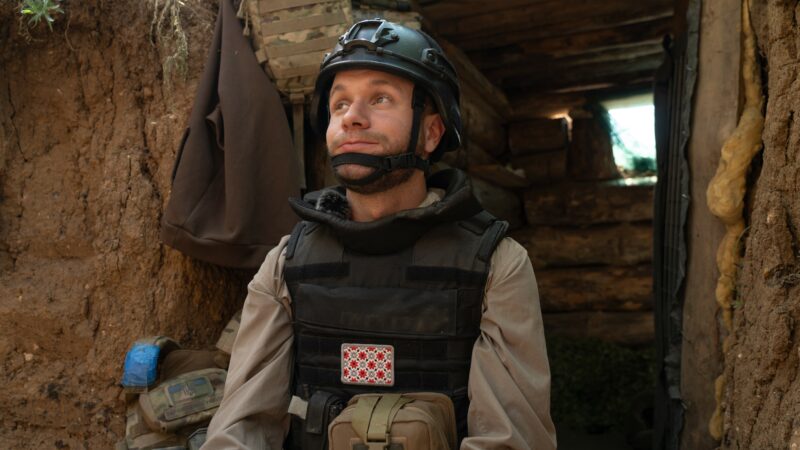
Journalist Francis Farrell has been reporting from the front lines of Russia’s war of aggression against Ukraine for over four years as a war correspondent for The Kyiv Independent. The English-language online newspaper was founded in late 2021. In 2023, Farrell received the Bayeux Calvados-Normandy Award for War Correspondents in the Young Reporter category for his coverage of the battle for Bakhmut in eastern Ukraine.
Mr. Farell, you have been working as a war correspondent for the English-language online newspaper The Kyiv Independent since the start of Russia’s full-scale invasion in February 2022. What does a typical workday look like for you?
When I’m working in Kyiv, I’m in my office in the city center—with all the amenities this city has to offer, despite the war. About every six to eight weeks, we head to the front lines. These assignments usually last one to two weeks. We stay in a town near the section of the front from which we’re reporting. Because of the many drones, we now keep a greater safety distance. On these assignments, we get little sleep. When we’re out with soldiers, our workday starts in the middle of the night. Then we stay at the combat positions for a day or two. Afterward, we might take a day off to rest. And then the work continues.
That sounds very routine. You yourself were born in Australia and studied International Studies in The Hague and London. What drives you to report from the war zones in Ukraine?
My studies focused on Ukraine, Russia, and the entire post-Soviet region. I learned Russian and Ukrainian and participated in a study exchange program in Russia. Even before Russia’s full-scale invasion, I enjoyed spending a lot of time in Ukraine. My main goal is to see things with my own eyes and talk to soldiers, commanders, and civilians. Russia’s attempt to capture Kyiv in a matter of days failed. But then a long war of attrition began. I want to report on how Ukraine is fighting back against Russia’s efforts to end its existence as an independent, free country, despite great adversity. I hope my work will reach politicians, diplomats, other media outlets, and citizens across Europe.
Is there a story, an encounter, or an observation from your research that captures the essence of what this war is about?
I believe I found the answer to that every time I traveled to Kherson in southern Ukraine. The first time I was there was shortly after the city was liberated from Russian occupation. At that time, people were walking the streets without fear for the first time in eight months, waving their Ukrainian flags with euphoria and relief. In the course of our research, many shocking stories came to light: they were about the systematic torture of Ukrainian civilians, the deportation of children, and the looting of the city’s cultural heritage.
The next time I was in Kherson was in the summer of 2023. At that time, Russia had deliberately caused flooding by destroying the Kakhovka dam. I waded through the water back then, watching as people were evacuated. Meanwhile, we came under fire. Since then, civilians have been attacked by small drones almost daily. The Russians are training their drone pilots on the other side of the river. For them, even a grandmother buying apples at the market or a child on a bicycle is a legitimate target.
You experience firsthand what Russian imperialism is doing in Ukraine. What is your impression of the people whose actions you report on: Russian soldiers, commanders, and politicians?
At first, I felt sympathy for the ordinary Russian soldiers because they had been forcibly conscripted and had only a limited understanding of what they were getting themselves into. Now, however, many soldiers are fighting primarily for the good money the Russian state pays them as a salary. When torturing civilians or prisoners of war, as well as in other war crimes, the perpetrators often display sadistic joy. After the invasion of Kursk, I had the opportunity to speak with Russian prisoners of war. Some of them have been brainwashed; others are malicious and extremely aggressive. Most, however, are simply completely empty inside. Yet even they made a conscious decision to participate in this war.
If you had the opportunity to interview Vladimir Putin—what would you ask him?
With someone like Putin, there’s no point in confronting him with morality. I think I would ask him something like: “You regularly speak of the liberation of the Donbas, but you have destroyed so many major cities, local industry, and people’s livelihoods—ending the lives of hundreds of thousands of people—are you truly being honest with yourself when you believe that this is liberation?” What do you say to the residents of Bakhmut, who lived in a beautiful city before your so-called special military operation, a city that no longer exists today?
Is there a story, an encounter, or an observation from the front lines that can help us readers in Central Europe better understand the war and its dynamics?
I recently spent a day with one of Ukraine’s elite drone teams. In a very direct and vivid way, I witnessed in real time how a Ukrainian drone pilot killed ten men on the other side of the front line in a single day by flying a first-person-view drone directly at them. That fundamentally changed my understanding of this war and the dynamics of warfare. By now, any target can be hunted shortly after its detection using simple precision weapons such as first-person-view drones. The NATO countries are completely unprepared for this.
At the same time, we should not forget that the infantry soldiers are still on the ground. In the summer of 2024, we were one of the last foreign-language media teams to be stationed at infantry positions—just 150 meters away from Russian soldiers. The atmosphere, the people, their faces, and the eyes of these individuals—to whom we owe our security not only in Kyiv but throughout Europe—were remarkable. They are holding the line and doing the deadliest and most difficult job. For me, this was a very important research trip.
How do you ensure your safety at the front?
Because of the drones, the area around the front line has turned into a veritable kill zone. First-person-view drones can fly up to 20 to 25 kilometers behind the traditional front line. The closer you get to the front line in a vehicle, the more likely you are to be attacked by a drone—even if you have electronic warfare capabilities to jam the enemy’s electronic signals. This makes driving in and out particularly dangerous. We were actually almost attacked by a drone once while driving out of the “kill zone.” Fortunately, nothing happened to us. Anyone who gets very close to the front line has to be extremely careful and pay close attention to how they move, avoiding exposing themselves too much in the open.
Does that mean, for example, that someone wearing a press vest—which identifies them as a reporter and is supposed to protect them from attacks—is actually exposing themselves as a target?
The example of Kherson shows that we should assume the Russians are targeting anything that moves—whether it’s soldiers, civilians, journalists, or humanitarian aid workers. For us journalists, a large press sticker or a conspicuous blue vest therefore effectively means nothing other than exposing ourselves as targets for attacks. To avoid being hit, we therefore wear low-profile press vests and camouflage clothing. As a rule, we never venture into the “kill zone” completely alone, but only with a military escort that has up-to-date situational intelligence.
What you describe sounds like a particularly stressful, potentially mentally taxing job, where it’s crucial to stay alert and present. What do you do, both as an individual and as a team, to support your mental health?
Of course, there’s no magic formula for that. As a team, we look out for one another, and if we feel that an assignment is taking a particularly heavy emotional toll on us, there’s the option of seeking professional help from a therapist. I think it requires the right balance: On the one hand, as a war reporter, you need to bring emotion, expressiveness, and empathy to the table. On the other hand, you have to be strong, resilient, and stable. Anyone who leans too heavily in either direction will either break down during the assignment or fail to connect with the people on the ground. I myself have been fortunate enough not to have experienced anything traumatic so far. But here we also need to look at the bigger picture.
In Ukraine, all of us—even in Kyiv—are regularly exposed to massive drone and missile attacks. As a reporter embedded with the military on the front lines, you’re protected and you have also been able to mentally prepare for your assignment. It’s a completely different experience when ballistic missiles strike near your home at night while you’re sleeping. Everyone in Ukraine has their own stories of loss, of burnout during the war. Added to this are the effects of Russian attacks on the national energy infrastructure. Reporting from the front lines as a war correspondent is therefore just a drop in the vast ocean of stress that all people in Ukraine are exposed to in the wake of Russia’s war of aggression.
As a war reporter, you are dependent on the Ukrainian military and rely on the goodwill of the state. Reliable, independent access to information is the foundation of good, professional journalism. What is that like for you?
Everything a war reporter does ultimately becomes part of the information war—for better or for worse. In the government, in civil society, or even among other self-proclaimed journalists, some believe that the information war. Access to information is indeed controlled—but the extent of that control and the criteria used depend heavily on the press officer of the respective brigade. Some press officers believe our job is to produce propaganda pieces about the courage and success of their soldiers. In my experience, however, many press officers value our work and have recognized that journalism must be realistic and truthful, and therefore must also show the ugly sides of war. I notice a difference in the various formats I produce. Video reports are primarily about atmosphere and sensory experience, usually focusing on a specific unit and the soldiers’ work. Of course, we also discuss problems in these reports.
However, the text format is much better suited for reporting on issues in the leadership culture of the Ukrainian military or on abuse and misconduct. This is because it allows the statements of soldiers and commanders to be anonymized in order to protect the identities of those involved and the sources. On the topic of corruption, for example, it would be more harmful to remain silent than to speak out. The same applies to all problems within the Ukrainian military. The fundamental moral truth of who the aggressor is in this war is, of course, not up for debate.